Blog
Marketing

From Early Access to GA: Building ODAIA Marketing Intelligence

ODAIA Marketing Intelligence is now generally available. This post covers what was shipped during the early access period, the reasoning behind each decision, and what real enterprise deployments taught us that internal testing never could.
By
Published on
May 19, 2026
Share this post
Return to Blog
|
7
min read

From Early Access to GA: Building ODAIA Marketing Intelligence

ODAIA Marketing Intelligence is now generally available. After more than a year in early access with multiple live pharma deployments, the product has moved from hypothesis to proven system.

This post covers what was built during the early adoptor period, the reasoning behind each decision, and what working in production with real HCP universes and real Rx data taught us that internal development never could.

For the short version, the GA announcement is here. If you want to understand how the product got to where it is, read on.

Why We Started With an Early Access Program

The core hypothesis behind Marketing Intelligence was straightforward: building upon the AI that guides field rep recommendations, should enable us to orchestrate a digital marketing campaign, and then use the feedback to prove whether it moved prescribing.

Testing this hypothesis required real conditions. Rather than launching broadly, we opened a limited program with existing clients to help guide our build and refine the system using real HCP universes, real campaign cycles, and real downstream Rx data.

The focus of the early adopter program was to prove whether we could tangibly help with:

  • HCP-level attribution; connecting a specific touchpoint to a specific prescription
  • Daily dynamic targeting and dispatch across an entire physician universe without manual intervention
  • Closed-loop Rx measurement that goes beyond engagement proxies (like clicks and opens)

An early access program with invested customers is a faster path to a working product than any amount of internal QA. Those deployments shaped what Marketing Intelligence is today.

The Problem We Were Actually Trying to Solve

Before getting into features, let's get specific about the problem.

Most pharma commercial teams have ample data. What they need is a better way to action on it. They use segments based on historical prescribing patterns and outreach occurs on a fixed calendar cadence that assumes relevance will take care of itself. It doesn't. Messages arrive before a decision is on the table, or after it's already been made. The physician is busy. The information feels disconnected from the patient in front of them. Relevance erodes slowly, and with it, the ROI on whatever was spent to generate that engagement.

The conventional response to this problem has been more signals: more data, smaller segments, more sophisticated personas. But more signals can't solve the issue of timing. The question isn't how to reach everyone. It's who is likely to need a specific piece of information right now.

That reframe is the foundation that Marketing Intelligence was built on. If you want to go deeper on the strategic case for journey mapping over segmentation, this post covers it in detail.

What We Shipped: A Functional Feature Walkthrough

The components below were delivered across the early access period. Each one addressed a specific gap we encountered in live deployments.

The Sequencing Engine and Dispatcher

What it does: The Sequencing Engine analyzes each HCP's Rx history, engagement behavior, channel eligibility, and journey stage daily. It generates a ranked recommendation per HCP: which channel, which message, what timing. The Dispatcher then takes those recommendations and automatically pushes them to media partners and agencies in their native formats.

Why it matters: This is the piece that removes the manual handoff loop. Before, a campaign cycle might involve segmentation, agency briefing, format conversion, upload, and then wait. Now the system runs that cycle daily, automatically, across every HCP in the universe. The orchestrator has maintained 100% uptime since February — that reliability is what makes daily automation viable in a production environment.

The Value Engine and PowerScore

What it does: Every HCP in a brand's universe receives a PowerScore from 10 to 0 representing their historical and predicted impact on the brand. That score influences who receives which tactics, at what investment level, and in what priority order.

Why it matters: Without a value signal, systems default to reach. More outreach to more physicians, hoping volume compensates for relevance. The PowerScore inverts that logic. Marketing spend concentrates on the physicians most likely to produce a script. It also creates the distribution logic that makes the Sequencing Engine smarter: high-value HCPs are distributed across sequencing groups so the model learns from them and improves recommendations for lower-volume physicians over time.

The Attribution Engine and Closed-Loop Reporting

What it does: The Attribution Engine statistically connects each HCP's marketing engagement to downstream Rx outcomes. Performance is measured across one-week tactic cycles with four weeks of Rx measurement. Two reports are generated per cycle: a Campaign Simulation Report before launch (projected outcomes, recommended sequences) and a Campaign Performance Report after (per-channel ROI, HCP-level engagement, script lift).

Why it matters: This is the engine that changes the conversation with leadership. Most omnichannel programs report on impressions, clicks, and open rates. The Attribution Engine reports on prescriptions. The simulation report also gives marketers a review-and-approve step before any tactics go live, which matters for teams that need to maintain visibility into what's being dispatched on their behalf.

For a closer look at what this means for pharma brand marketers specifically, the solution page walks through the practical implications.

Salesforce Marketing Cloud Integration

What it does: Recommendations from the Sequencing Engine are pushed directly into SFMC as an activation partner, alongside existing integrations.

Why it matters: Enterprise pharma teams are already working in Salesforce. An integration means Marketing Intelligence flows into an existing workflow rather than requiring a parallel one. This integration also validated a reusable technical pattern: the SFMC pipeline built for one customer required handling new authentication types, pagination, and nested response data, and those improvements now make every future integration faster and easier.

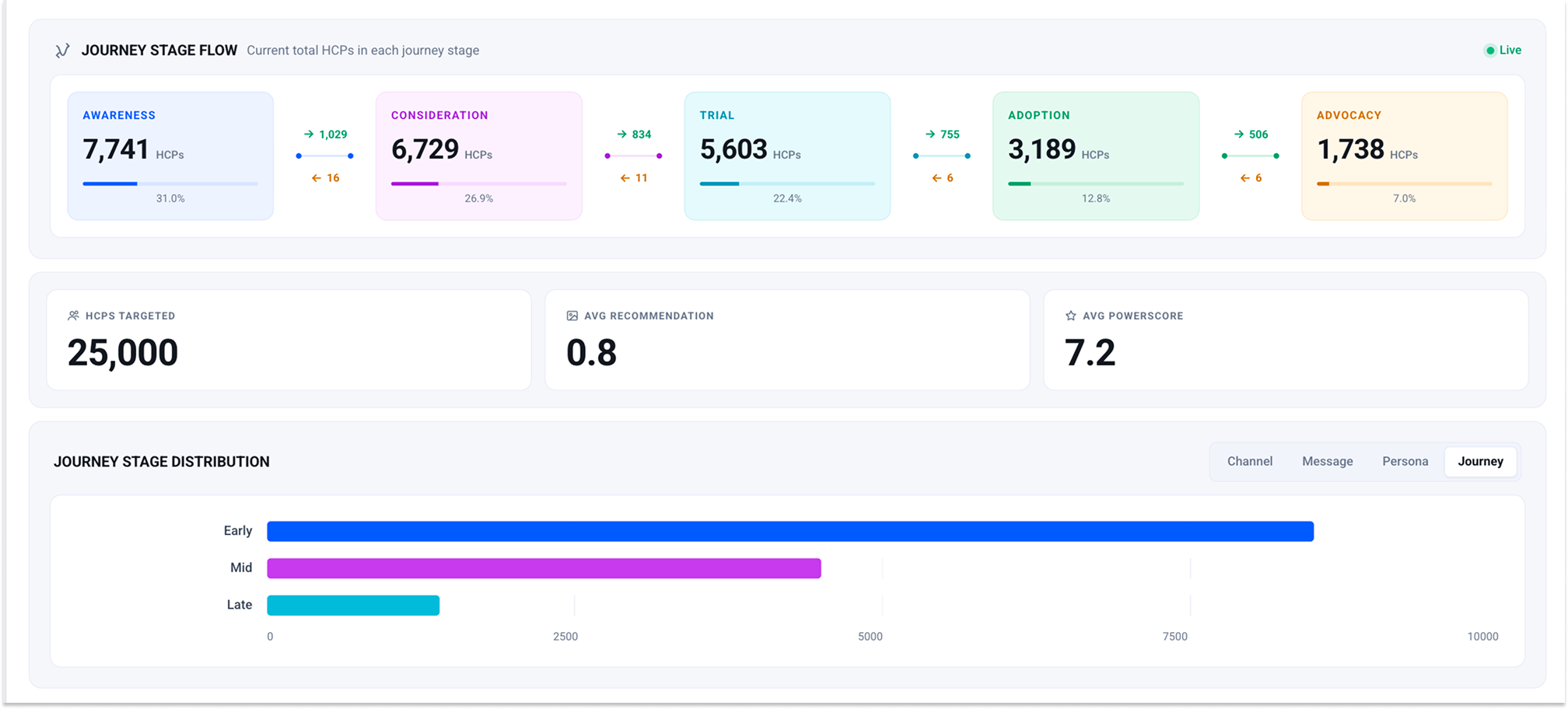
Journey Stage Detection (v1)

What it does: A data-driven mechanism for detecting where each HCP sits in the prescribing funnel. The system uses two types of analysis:

  • Pre-first Rx: Combines engagement velocity (how fast an HCP's engagement with the brand is changing) and Rx drop velocity (how fast competitive prescriptions are declining). Those signals are used to place each HCP into a stage: Awareness, Consideration, or Prescribe.
  • Post-first Rx: Uses market share data to determine where prescribers fall across Trialist, Adopter, and Advocate stages, identifying the natural boundaries between each group.

Why it matters: Patterns surface around physicians who are encountering patients near a decision point, even before a formal diagnosis has been recorded. Identifying those leading signals makes it possible to recognize emerging prescribing behavior before it shows up in a quarterly segment refresh. For customers who don't have their own journey stage classifications, the system builds them automatically from the data.
Message-Only Sequencing (v1)

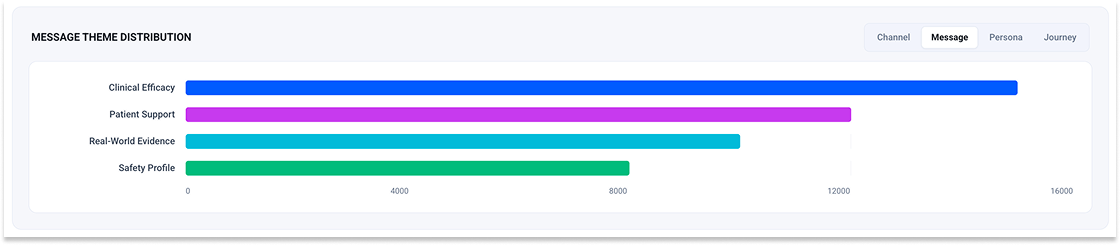
What it does: The Sequencing Engine can generate recommendations at the content level: which message, in what order, at what timing, independent of channel. If clients specify a content tagging hierarchy, the engine generates a personalized sequence of up to three messages per HCP based on delivered message history.

Why it matters: In pharma, new content takes 90 days to six months to clear regulatory review. Teams make large content investment decisions with limited signal on what's worth producing. Message-only sequencing gives marketing teams data-backed insight into which messages are driving engagement and influencing prescribing — before the approval clock starts on the next round of content.
Field Integration (v1)

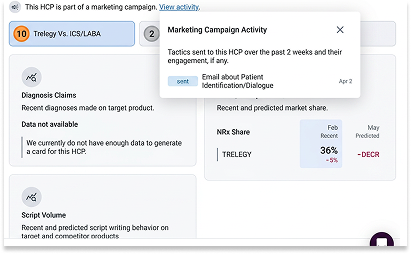
What it does: Sales reps can now see, inside their call plan, whether an HCP has been targeted by a marketing campaign. A new insight in the call plan interface lets reps view the marketing events that an HCP engaged with over the past two weeks. Data is loaded from the partner API in near real-time.

Why it matters: This is the feature that makes the field-digital coordination story concrete. The friction it addresses is well-documented: marketing and field teams operate from separate datasets on separate cadences, and HCPs experience the inconsistency. A rep walking into a visit now knows that the physician received a brand email yesterday and engaged with a clinical summary. That context changes the conversation. The next phase builds the bridge in the other direction, giving marketers visibility into field activity from the same interface.
What the Numbers Look Like in Practice

The deployment data from the early access period gives a clearer picture of what the system produces at scale. The full case study covers the methodology and results in detail — find the summary below.

Metric Figure
Total HCP Universe 70,000 HCPs
High-value targets identified 33,682 HCPs
Received a tactic via automated dispatch 33,518 HCPs
Engaged with content 26,807 HCPs (80%)
Converted to writing a prescription 10,645 HCPs (39.7%)

Narrowing from 70k physicians to 33k+ targets is not a limitation of the system. It is the point. Those HCPs were identified by forward-looking behavioral signals that conventional segmentation based on historical prescribing would have missed. Precision outperformed reach in every cycle.

How the Model Improves Over Time

One outcome that doesn't show up in a single-cycle report: the compounding effect of a closed attribution loop.

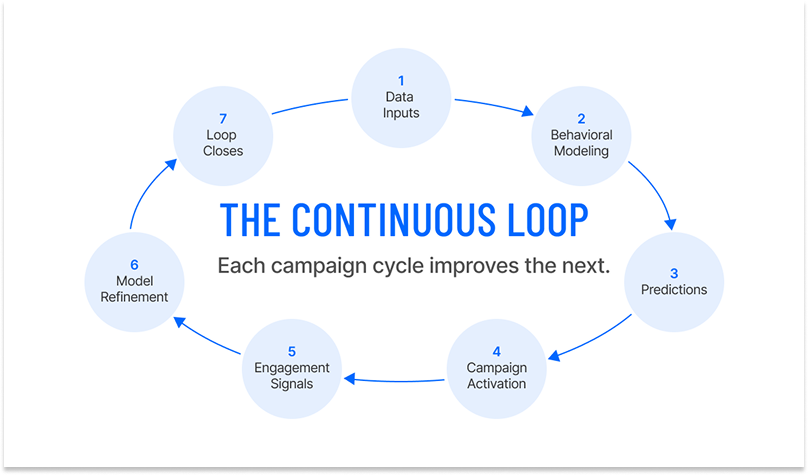
Attribution data feeds back into the Sequencing Engine continuously. Each cycle's recommendations are informed by the results of the previous one: which channels produced engagement, which messages moved which HCPs, which sequences correlated with Rx activity. The system doesn't reset between cycles. It learns.

A brand starting with one cycle of data will have a meaningfully stronger model six cycles in, without any additional lift from the marketing team. The brands that deployed during early access have been compounding that advantage for months. That gap is real and it grows every cycle.
What General Availability Means

Campaign Intelligence is now Marketing Intelligence. The updated name reflects a real change in scope. This is a marketer-first product with field coordination built in, not a field intelligence platform with a marketing module added later.

General availability means: 

  1. The system has been validated with enterprise pharma brands
  2. Daily automation is proven at scale (100% uptime across the early access period)
  3. The partner integration network is live and expanding
  4. New customers can get started now

The roadmap continues. Bi-directional field-marketing data sharing, expanded real-time integrations with CRMs and other field platforms, and a growing activation partner network are in progress.

If you want to see what a deployment looks like for your brand, we're ready to show you.
Book a discovery call with our team.

Return to Blog
Marketing
|
7
min read

From Early Access to GA: Building ODAIA Marketing Intelligence

ODAIA Marketing Intelligence is now generally available. This post covers what was shipped during the early access period, the reasoning behind each decision, and what real enterprise deployments taught us that internal testing never could.
Written by
Published on
May 19, 2026

ODAIA Marketing Intelligence is now generally available. After more than a year in early access with multiple live pharma deployments, the product has moved from hypothesis to proven system.

This post covers what was built during the early adoptor period, the reasoning behind each decision, and what working in production with real HCP universes and real Rx data taught us that internal development never could.

For the short version, the GA announcement is here. If you want to understand how the product got to where it is, read on.

Why We Started With an Early Access Program

The core hypothesis behind Marketing Intelligence was straightforward: building upon the AI that guides field rep recommendations, should enable us to orchestrate a digital marketing campaign, and then use the feedback to prove whether it moved prescribing.

Testing this hypothesis required real conditions. Rather than launching broadly, we opened a limited program with existing clients to help guide our build and refine the system using real HCP universes, real campaign cycles, and real downstream Rx data.

The focus of the early adopter program was to prove whether we could tangibly help with:

  • HCP-level attribution; connecting a specific touchpoint to a specific prescription
  • Daily dynamic targeting and dispatch across an entire physician universe without manual intervention
  • Closed-loop Rx measurement that goes beyond engagement proxies (like clicks and opens)

An early access program with invested customers is a faster path to a working product than any amount of internal QA. Those deployments shaped what Marketing Intelligence is today.

The Problem We Were Actually Trying to Solve

Before getting into features, let's get specific about the problem.

Most pharma commercial teams have ample data. What they need is a better way to action on it. They use segments based on historical prescribing patterns and outreach occurs on a fixed calendar cadence that assumes relevance will take care of itself. It doesn't. Messages arrive before a decision is on the table, or after it's already been made. The physician is busy. The information feels disconnected from the patient in front of them. Relevance erodes slowly, and with it, the ROI on whatever was spent to generate that engagement.

The conventional response to this problem has been more signals: more data, smaller segments, more sophisticated personas. But more signals can't solve the issue of timing. The question isn't how to reach everyone. It's who is likely to need a specific piece of information right now.

That reframe is the foundation that Marketing Intelligence was built on. If you want to go deeper on the strategic case for journey mapping over segmentation, this post covers it in detail.

What We Shipped: A Functional Feature Walkthrough

The components below were delivered across the early access period. Each one addressed a specific gap we encountered in live deployments.

The Sequencing Engine and Dispatcher

What it does: The Sequencing Engine analyzes each HCP's Rx history, engagement behavior, channel eligibility, and journey stage daily. It generates a ranked recommendation per HCP: which channel, which message, what timing. The Dispatcher then takes those recommendations and automatically pushes them to media partners and agencies in their native formats.

Why it matters: This is the piece that removes the manual handoff loop. Before, a campaign cycle might involve segmentation, agency briefing, format conversion, upload, and then wait. Now the system runs that cycle daily, automatically, across every HCP in the universe. The orchestrator has maintained 100% uptime since February — that reliability is what makes daily automation viable in a production environment.

The Value Engine and PowerScore

What it does: Every HCP in a brand's universe receives a PowerScore from 10 to 0 representing their historical and predicted impact on the brand. That score influences who receives which tactics, at what investment level, and in what priority order.

Why it matters: Without a value signal, systems default to reach. More outreach to more physicians, hoping volume compensates for relevance. The PowerScore inverts that logic. Marketing spend concentrates on the physicians most likely to produce a script. It also creates the distribution logic that makes the Sequencing Engine smarter: high-value HCPs are distributed across sequencing groups so the model learns from them and improves recommendations for lower-volume physicians over time.

The Attribution Engine and Closed-Loop Reporting

What it does: The Attribution Engine statistically connects each HCP's marketing engagement to downstream Rx outcomes. Performance is measured across one-week tactic cycles with four weeks of Rx measurement. Two reports are generated per cycle: a Campaign Simulation Report before launch (projected outcomes, recommended sequences) and a Campaign Performance Report after (per-channel ROI, HCP-level engagement, script lift).

Why it matters: This is the engine that changes the conversation with leadership. Most omnichannel programs report on impressions, clicks, and open rates. The Attribution Engine reports on prescriptions. The simulation report also gives marketers a review-and-approve step before any tactics go live, which matters for teams that need to maintain visibility into what's being dispatched on their behalf.

For a closer look at what this means for pharma brand marketers specifically, the solution page walks through the practical implications.

Salesforce Marketing Cloud Integration

What it does: Recommendations from the Sequencing Engine are pushed directly into SFMC as an activation partner, alongside existing integrations.

Why it matters: Enterprise pharma teams are already working in Salesforce. An integration means Marketing Intelligence flows into an existing workflow rather than requiring a parallel one. This integration also validated a reusable technical pattern: the SFMC pipeline built for one customer required handling new authentication types, pagination, and nested response data, and those improvements now make every future integration faster and easier.

Journey Stage Detection (v1)

What it does: A data-driven mechanism for detecting where each HCP sits in the prescribing funnel. The system uses two types of analysis:

  • Pre-first Rx: Combines engagement velocity (how fast an HCP's engagement with the brand is changing) and Rx drop velocity (how fast competitive prescriptions are declining). Those signals are used to place each HCP into a stage: Awareness, Consideration, or Prescribe.
  • Post-first Rx: Uses market share data to determine where prescribers fall across Trialist, Adopter, and Advocate stages, identifying the natural boundaries between each group.

Why it matters: Patterns surface around physicians who are encountering patients near a decision point, even before a formal diagnosis has been recorded. Identifying those leading signals makes it possible to recognize emerging prescribing behavior before it shows up in a quarterly segment refresh. For customers who don't have their own journey stage classifications, the system builds them automatically from the data.

Message-Only Sequencing (v1)

What it does: The Sequencing Engine can generate recommendations at the content level: which message, in what order, at what timing, independent of channel. If clients specify a content tagging hierarchy, the engine generates a personalized sequence of up to three messages per HCP based on delivered message history.

Why it matters: In pharma, new content takes 90 days to six months to clear regulatory review. Teams make large content investment decisions with limited signal on what's worth producing. Message-only sequencing gives marketing teams data-backed insight into which messages are driving engagement and influencing prescribing — before the approval clock starts on the next round of content.

Field Integration (v1)

What it does: Sales reps can now see, inside their call plan, whether an HCP has been targeted by a marketing campaign. A new insight in the call plan interface lets reps view the marketing events that an HCP engaged with over the past two weeks. Data is loaded from the partner API in near real-time.

Why it matters: This is the feature that makes the field-digital coordination story concrete. The friction it addresses is well-documented: marketing and field teams operate from separate datasets on separate cadences, and HCPs experience the inconsistency. A rep walking into a visit now knows that the physician received a brand email yesterday and engaged with a clinical summary. That context changes the conversation. The next phase builds the bridge in the other direction, giving marketers visibility into field activity from the same interface.

What the Numbers Look Like in Practice

The deployment data from the early access period gives a clearer picture of what the system produces at scale. The full case study covers the methodology and results in detail — find the summary below.

Metric Figure
Total HCP Universe 70,000 HCPs
High-value targets identified 33,682 HCPs
Received a tactic via automated dispatch 33,518 HCPs
Engaged with content 26,807 HCPs (80%)
Converted to writing a prescription 10,645 HCPs (39.7%)

Narrowing from 70k physicians to 33k+ targets is not a limitation of the system. It is the point. Those HCPs were identified by forward-looking behavioral signals that conventional segmentation based on historical prescribing would have missed. Precision outperformed reach in every cycle.

How the Model Improves Over Time

One outcome that doesn't show up in a single-cycle report: the compounding effect of a closed attribution loop.

Attribution data feeds back into the Sequencing Engine continuously. Each cycle's recommendations are informed by the results of the previous one: which channels produced engagement, which messages moved which HCPs, which sequences correlated with Rx activity. The system doesn't reset between cycles. It learns.

A brand starting with one cycle of data will have a meaningfully stronger model six cycles in, without any additional lift from the marketing team. The brands that deployed during early access have been compounding that advantage for months. That gap is real and it grows every cycle.

What General Availability Means

Campaign Intelligence is now Marketing Intelligence. The updated name reflects a real change in scope. This is a marketer-first product with field coordination built in, not a field intelligence platform with a marketing module added later.

General availability means: 

  1. The system has been validated with enterprise pharma brands
  2. Daily automation is proven at scale (100% uptime across the early access period)
  3. The partner integration network is live and expanding
  4. New customers can get started now

The roadmap continues. Bi-directional field-marketing data sharing, expanded real-time integrations with CRMs and other field platforms, and a growing activation partner network are in progress.

If you want to see what a deployment looks like for your brand, we're ready to show you.
Book a discovery call with our team.
Are you a thought leader in the industry?

Share this blog with your network!

odaiaAI